Difference Between Traditional Flange and Compact Flange?
Anyone who has spent time around industrial piping systems knows that flanges are everywhere. They connect pipe sections, tie in valves, and allow systems to be broken apart for maintenance. For most of the last century, the standard ANSI and API flange has been the default choice across industries. But as operational demands have grown, so have the limitations of that default.
Compact flanges have steadily taken ground in critical applications, and for good reason. Understanding the traditional flange vs compact flange distinction is not just a technical exercise. For engineers and plant managers, it is a decision that directly affects safety, cost, and long-term reliability.
How Traditional Flanges Work
A conventional flange creates a seal by clamping a soft gasket between two flat or raised face surfaces using a ring of bolts. The gasket material, whether spiral wound, ring type joint, or compressed fiber, fills in surface imperfections and holds pressure as long as the bolt load remains sufficient.
The problem is that this system depends entirely on a consumable component. Gaskets creep, harden, and degrade. Bolts relax over thermal cycles. Vibration loosens the clamp load over time. In high-pressure or high-temperature environments, these failure points compound quickly. That is the core weakness in the compact flange vs standard flange conversation, and it is the reason facilities dealing with critical service lines keep facing the same recurring leak problems.
Traditional flanges are also large. The bolt circle must be wide enough to accommodate multiple fasteners, and the flange faces need sufficient surface area to compress the gasket evenly. That bulk translates directly into weight, and weight is a liability in offshore platforms, modular construction, and any installation where structural loads are carefully managed.
How Compact Flanges Work
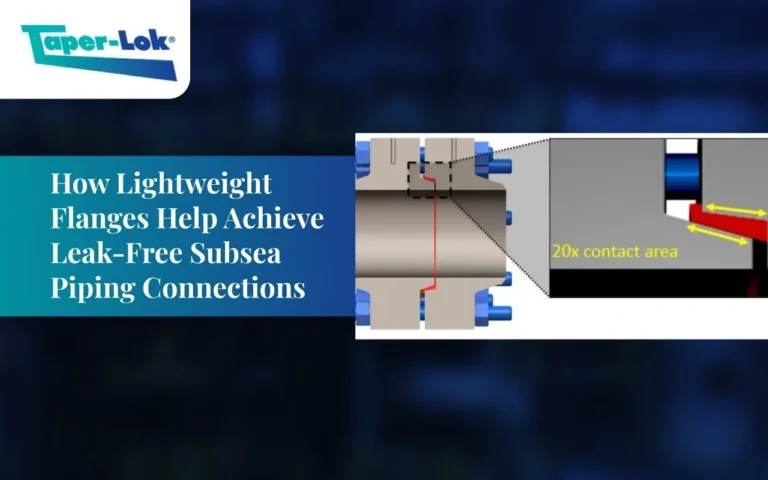
Compact flanges take a different approach entirely. Instead of relying on a gasket, they use metal-to-metal contact to create the seal. The sealing surfaces are precision-machined to engage directly under controlled bolt load. When system pressure increases, the geometry of the connection actually tightens the seal further rather than threatening it.
This is what separates a high pressure leak-free compact flange from its conventional counterpart. The seal is not dependent on a consumable material. It is built into the mechanical relationship between the two metal surfaces, and it stays intact across pressure cycles, temperature swings, and vibration loads that would cause a gasket to give out.
Because the bolt circle is smaller and fewer fasteners are needed to achieve the required clamp load, the overall flange diameter shrinks considerably. That reduction in size is what gives compact flanges their name and their value.
Where the Difference Shows Up in Practice
The compact flange benefits become most visible in applications where traditional flanges consistently underperform. Offshore floating platforms are a clear example. A lightweight compact flange can weigh up to 80% less than an equivalent ANSI flange. Across an entire topside, that weight reduction can reach over one million pounds, directly reducing structural requirements and platform cost.
In subsea and riser applications, compact flanges install significantly faster, cutting diver time and offshore labor expenses. In petrochemical refineries and heat exchanger systems, the elimination of gaskets means fewer planned shutdowns and lower maintenance costs per cycle. Some facilities report saving up to $400,000 per exchanger per planned shutdown after switching.
The difference between traditional flange and compact flange also matters in tight spaces. Compact flanges have a smaller footprint, which simplifies pipe routing in congested areas and reduces overall material requirements for support structures.
Choosing the Right Manufacturer
Not all compact flanges deliver on the same performance standard. Working with experienced pipe flange manufacturers in the USA who specialize in engineered connection systems ensures that the design, materials, and tolerances are matched to the specific demands of your application. Taper-Lok Technologies, based in Houston, Texas, has spent decades engineering compact flange solutions for subsea pipelines, offshore platforms, refineries, aerospace systems, and heat exchangers across both hemispheres.
The Short Answer
Traditional flanges depend on gaskets that wear out. Compact flanges depend on metal geometry that does not. That difference, in terms of weight, footprint, maintenance burden, and long-term leak risk, is the entire argument for making the switch.