Why Lightweight Flange Connectors Ideal for Heat Exchangers
Heat exchangers are among the most maintenance-intensive assets in any industrial facility. They run continuously, cycle through pressure and temperature changes repeatedly, and carry process fluids that range from corrosive chemicals to high-temperature steam. The connections at the channel cover and tubesheet are under constant mechanical stress, and in facilities running conventional ANSI flanges at those points, leaks are not a question of if. They are a question of when.
Switching to lightweight flange connectors for heat exchangers addresses the problem at the source rather than managing it through inspection cycles and unplanned interventions.
Why Heat Exchanger Connections Fail
The channel cover and tubesheet connections on a heat exchanger go through more mechanical punishment than most other flanged joints in a facility. Every startup and shutdown puts the gasket through a full compression and relaxation cycle. Every process excursion adds thermal load. Over months and years of continuous operation, the bolt load that keeps the gasket compressed gradually relaxes, and the seal begins to deteriorate.
Gasket-sealed flanges in heat exchanger service also carry an additional vulnerability. The large diameter of channel cover flanges means that achieving even bolt load distribution across the full face is genuinely difficult. Uneven compression leaves pockets of low contact stress that become leak paths under operating pressure, and once a large-diameter gasket starts to weep, the repair almost always requires a full shutdown.
For facilities running multiple exchangers, this pattern repeats across every unit on every planned and unplanned outage, driving up maintenance costs and squeezing production schedules.
The Case for Compact Flanges in Heat Exchanger Applications
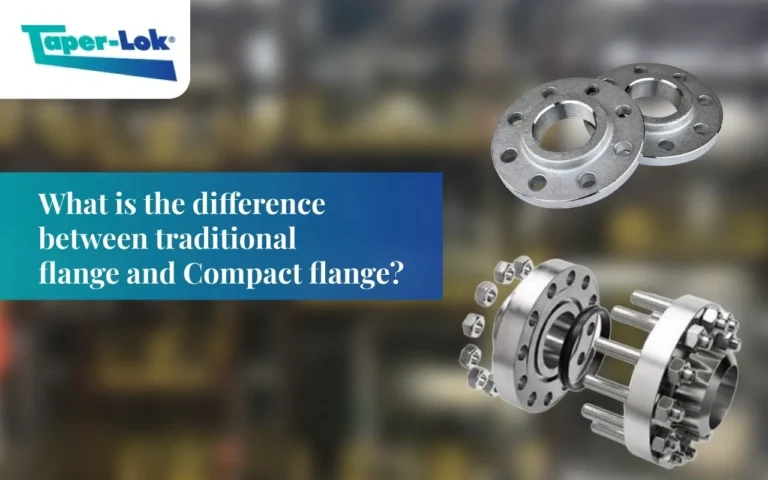
Compact flanges for heat exchangers solve this problem through a combination of better sealing geometry and significantly reduced weight. Where a conventional ANSI flange relies on gasket compression held by a wide bolt circle, a compact metal-to-metal sealing flange uses precision taper geometry to create a seal that is independent of any consumable material.
The self-energizing nature of the metal-to-metal seal means that pressure increases tighten the connection rather than threatening it. In heat exchanger service, where pressure and temperature fluctuations are constant, that behavior is exactly what a reliable connection needs. There is no gasket to replace, no soft material to extrude under load, and no maintenance schedule built around a component that was always going to wear out.
Piping Load Reduction is a Structural Advantage
Beyond sealing performance, heat exchanger piping load reduction is a significant operational benefit that often goes underappreciated. Conventional ANSI flanges at channel cover and nozzle connections are heavy. On large exchangers, that weight adds up across multiple connection points, placing sustained load on nozzles, pipe supports, and the exchanger shell itself.
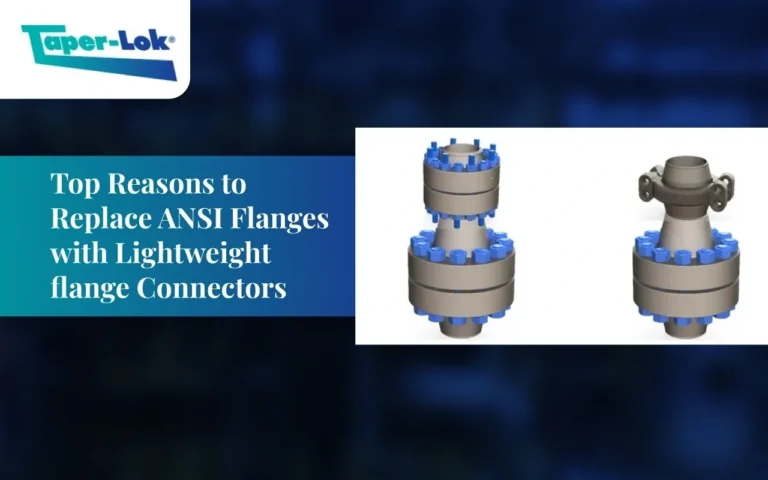
Lightweight flange connectors for heat exchangers can weigh up to 80% less than equivalent ANSI flanges. That reduction relieves nozzle loading, reduces stress on connecting pipework, and can extend the service life of the exchanger shell by removing a chronic source of mechanical strain. In facilities with multiple large exchangers, the cumulative piping load reduction across a unit represents a meaningful structural benefit.
Leak Prevention That Pays for Itself
Heat exchanger leak prevention through metal-to-metal sealing technology has a direct and measurable financial impact. Facilities using Taper-Lok seal rings on channel covers and tubesheets report savings of up to $400,000 per planned shutdown per exchanger, through reduced parts cost, shorter downtime, and fewer days of lost production.
For a facility running several exchangers through annual or biannual shutdowns, those numbers compound quickly. The upfront investment in compact flanges for heat exchangers pays back through eliminated gasket replacement costs, faster turnaround times, and the removal of leak-driven unplanned outages that are far more expensive than any planned maintenance event.
The connection between a heat exchanger and its piping system should be the last thing a maintenance team worries about. With the right lightweight flange connectors for heat exchangers, it can be.