Top Reasons for Leakage in High-Pressure Pipe Connections
A leak in a high-pressure piping system is rarely just an inconvenience. Depending on the process fluid and operating conditions, it can mean lost production, environmental liability, safety hazards, or a full unplanned shutdown. What makes it more frustrating is that most leaks are not random events. They follow predictable patterns, and they almost always trace back to the same root causes.
If you are dealing with recurring high pressure pipe connection leaks, understanding why they happen is the first step toward stopping them for good.
Gasket Failure
This is the most common cause of leakage in flanged systems, and it is a structural problem, not a maintenance oversight. A gasket leaking in service is often the result of material degradation that was always going to happen. Gaskets creep under sustained bolt load, harden after repeated thermal cycling, and lose their sealing ability in corrosive or erosive service conditions.
Even a correctly installed gasket will begin to relax after the first few pressure and temperature cycles. Over time, the clamp load drops, contact stress between flange faces decreases, and the system finds the path of least resistance. This is one of the primary causes of leakage in high pressure pipe connections that facilities continue to deal with despite regular inspection schedules.
Improper Bolt Load and Uneven Tightening
A flange connection is only as good as the bolt load holding it together. Under-torqued bolts leave the gasket under-compressed and vulnerable to pressure breakthrough. Over-torqued bolts can crush or extrude the gasket, creating uneven sealing contact that leaks just as readily.
Bolt load also distributes unevenly around the flange face unless a precise cross-tightening sequence is followed. In field conditions, under time pressure, that sequence does not always get the attention it needs. The result is a flange leaking in high pressure systems that looks tight from the outside but has pockets of low contact stress where leakage initiates.
Misalignment During Assembly
Misaligned pipe connection leakage is more common than most maintenance teams want to acknowledge. When two pipe ends are not brought into proper alignment before the flange is tightened, the gasket experiences uneven compression across its face. One side gets squeezed harder than the other, and the underloaded side becomes the leak path.
Misalignment also introduces bending stress into the bolts and flange faces, accelerating fatigue and making future leaks more likely even after retightening. In offshore and subsea installations where pipe positioning is difficult, this is a significant contributor to high pressure pipeline leak causes.
Vibration, Thermal Cycling, and Surface Damage
Pipelines near rotating equipment experience sustained vibration that gradually works at bolt load through self-loosening. As tension drops incrementally, the gasket loses the compression holding the seal together. This is a slow failure mode, which makes it particularly dangerous because it deteriorates over months before a pressure excursion reveals the problem.
Thermal expansion compounds this further. Every heat-up and cool-down cycle causes bolts and flange bodies to move at different rates, progressively relaxing the clamp load. Add corrosion pitting or surface damage on the flange face, and no gasket material can fully bridge the resulting gaps. Once the sealing surface is compromised, the only real fix requires downtime.
The Case for Removing the Gasket Entirely
Every cause listed above either involves the gasket directly or weakens the system holding it in place. The most reliable way to address causes of leakage in high pressure pipe connections is to eliminate the gasket from the equation altogether.
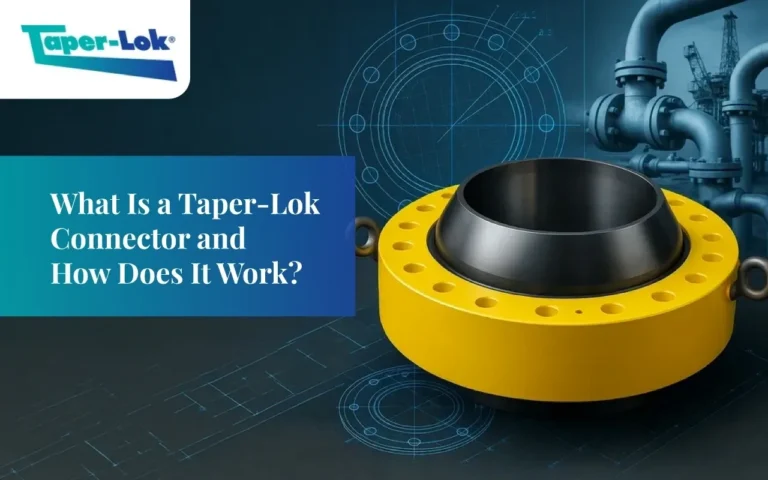
Taper-Lok leak-free pipe connectors do exactly that. Using a patented metal-to-metal taper seal geometry, Taper-Lok connections create a self-energizing seal that tightens as internal pressure increases, with no gasket to degrade and no consumable component to schedule for replacement. Spherical nose configurations also accommodate angular misalignment during assembly, removing another major source of field-installed leaks.
For facilities tired of tracking the same connections across every shutdown, Taper-Lok leak-free pipe connectors offer a permanent fix rather than another maintenance interval.